The Dublin InQuirer has raised some eyebrows since going live a few months ago. It has quite an interesting perspective including articles on the role of finance capital in the city and good critical coverage on the goings on in the city council. Coverage of the work of housing activists has been included and the site broke the shocking story of homeless families being forced to use the side entrance of hotels. The web based publication comes out every Wednesday and as well as the what we would expect from a local news site such a city desk, arts and cuisine articles and a what’s on section what really caught our eye is the ‘unreal estate‘ planning and property section which as the name implies has a far more critical outlook compared to the ubiquitous estate agent driven property porn found in mainstream journalism. The site also includes interesting ‘long reads’, such as one on the life and work of cat catchers in the city. Columnists include Frank McDonald previously of the Irish Times, the aforementioned Andy Story who covers economics and Roe McDermott an advice columnist. The site practices what founder Lois Kapila describes as a more traditional approach to journalism and writing compared to the PR driven churnalism that has increasingly become the norm. We sent Lois some questions to find out a little more about Dublin’s latest media product who discusses issues such as funding models, journalistic style and practice and mainstream media plagiarism.

Lois Kapila
Congratulations on the new news site, the first question is why did you decide to set about establishing it?
Thanks! I set it up because I thought there was a gap in the market for in-depth city coverage, and that there were many stories that weren’t being told. Also, I was working as a struggling freelance journalist in Dublin before this, and I couldn’t find many places that would run the kind of stories that I wanted to write – in-depth local journalism.
I grew up in the UK and there, at least, local journalism seems to be looked upon as second-class journalism. It isn’t really respected as much as the nationals. In 2009, I interned really briefly over a summer for an alt weekly publication in the US called Washington City Paper, and what they were doing there really blew me away. That changed my idea of what local journalism could be.
As well as all that, I wanted to create opportunities for young reporters to go out and about and do what some might consider more old-fashioned shoe-leather reporting, rather than maybe rewriting press releases or sitting at their desks reporting on tweets. I hope that we’re going to be a good training ground for journalists who can then go on to grander places that can pay them more.
 How long have you been up and running? Are you finding your feet?
We’ve been up and running since June this year and I think we are finding our feet. It’s taking us a bit of time to get to know our beats, and to become known on them — simple things such as being recognised as press at city council meetings.
The mindset that a reporter needs for a weekly publication, rather than a daily, or hourly, is different. You need to think a bit more about where the debate is headed, find stories that aren’t going to have been published elsewhere by the time you go to press, and justify having that bit more time to report. So that’s a learning curve too.
I feel like we’ve got the basics in place now, and there are different longer-term projects that we need to start working on, particularly using data, to make the most of being an online publication. We’re not exactly where we want to be yet, but I think we’ll get there.
Question three is of particular interest to media activists is how did you go about establishing it? And as much as you feel comfortable telling us do you have a particular funding model? We notice for example you offer editorial services and a shop, is this intention to leave you a little less dependent on advertising?
At the moment, it’s funded with some start-up funding that I have been extremely privileged – and am slightly nervous – to have got from family. I did apply for, and continue to apply for, different grants but haven’t managed to bag one yet.
I obviously did a lot of talking to people and reading about different models for local media before we got set up, and I thought that we would find it really tough to survive if we were completely dependent on advertising. So we are trying to work on numerous revenue streams in addition to advertising, as you noticed: editorial services, an online shop, our membership scheme.
As a local publication, focused on the kind of journalism that we are, we’re never going to get as much traffic as a national with rolling breaking news and celebrity tidbits might. Perhaps I’m wrong, but I think it’s safe to work on that assumption.
So we’re working to build up a smaller core of loyal readers who spend more time on the website, and like what we do, and give what they can when they can. It’s healthy to have that focus on readers, I think, and in the future, I want to build up our membership scheme, so that those who donate to us do get more than a tote bag; I’d love to be able to give them discounts at different places in the city, and to run more events for them.
The danger of having all these streams, of course, is spreading ourselves too thin. We are a small team and so finding time to manage them all, and keep them moving, is tricky.
In the future, I’d love Dublin Inquirer to become a newspaper part-owned by its readers. I envisage some kind of equity crowd-funding model, where in exchange for a contribution, the readers become part-owners.
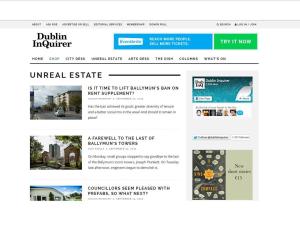 The site seems to have a particular interest in planning and housing, and it has to be said has a far more critical attitude towards it compared to what we are accustomed to, for example your ‘unreal estate’ section, is this area of particular interest to you, and why?
I think it’s of interest to us, because it’s something that our readers want to know about and we all struggle with issues like rising rents and substandard accommodation. If you live in the city, you can’t help but take an interest in the built environment.
As for taking a more critical attitude, to me that just seems the default approach that we should have to it. It’s also more interesting, I think, than property porn.
I genuinely don’t understand how you can have such blatant property porn, thinly disguised adverts, on the front page of the Irish Times website, for example. Sometimes, right up there at the top of the page. How can a national newspaper of record think that the potential sale of one multi-million-euro home somewhere in the country is deserving of that kind of exposure?
When I first moved to Ireland, the second apartment I lived in with my husband had mould all over and broken windows. The ceiling fell down and the landlord had complete control over the heat and left it off for the winter. And it’s really difficult to function and stay healthy when you’re living in those conditions. But if nowhere else will take you because there’s a shortage and you don’t have references and you’re broke, what are you going to do?
So, I do feel passionate about housing. Also, we are a city paper, and we aim to focus on local government. And housing and planning are some of the areas where the council does actually have influence. So that, too, means it’s a natural reporting area for us.
We have also noticed what seems to be wider range of opinion on your site compared to the mainstream, especially around property, is this a policy?
I’m glad you think that we have a wide range of opinion on the site! I guess it’s a policy to be open to submissions and have a wide range of informed voices. I don’t understand why any publication or editor would make themselves difficult to reach.
I would like us to have more diversity, though, in terms of ethnic minority contributors, for example. I think the media in Ireland does not reflect the diversity out on the streets. I know that immigration is newer here than in the UK, for example, and for some immigrants, language will be a problem, but I think we have to try harder to open up opportunities for people from new communities to get a break in journalism.
For those who worry that somebody from somewhere else can’t possibly understand what’s going on here, I would point out that our planning and transport reporter is from the US and his stories are smart and spot on.
Are you going to be engaging in investigative journalism on the site?
I would love to be able to do more investigative journalism on the site.
To me, investigative journalism is just great reporting that takes more time. At the moment, we’re a small team and so that’s a struggle. But I think we’ll get better at juggling longer projects with weekly pieces and that’s definitely something that we’ll be working on.
In any case, I think we should approach all stories with the mindset that you might associate with investigative journalism, and ask, “What do I want to know?” rather than, “What will people tell me right now?”
How would you describe yourself editorially?
I think that our mission, for want of a better word, is simple: to tell people stories that help them to understand what’s going on in the city, and present them in a way that’s enjoyable to read. And some of those will be the more medicinal, we-think-you-should-know-this stories, and some will be the softer, we-think-you’d-smile-at-this stories.
I don’t really give any thought to where we might fall in terms of “on the left” or “on the right”. To me, that’s irrelevant. We’re independent. When we’re reporting stories, our focus is simply to figure out what’s going on and tell our readers.
Our voice is more informal and, at times, some might say less measured than some publications. But I think there’s a danger with some publications that they confuse having a neutral voice with “unbiased” journalism and sometimes hide behind that style. It’s the reporting process, and being transparent about where information came from, that determines whether a piece is accurate and honest or not.
Are there any sites, papers or models from outside Ireland you admire or would like to emulate.
There are so many sites and papers that I read and admire and would love to be even a shade as good as, particularly in the US. I love the alt weeklies such as Washington City Paper with their long-form narrative style and grit. I love regional publications like This Land Press which seems to be succeeding at building a sense of community around the publication, has a quality print quarterly, and is great-looking. And I love Tampa Bay Times, where even the simplest story is done with such care, such as this one about sports fans or this one about an astronomer. I also love Texas Monthly. In India, Caravan has incredible political profiles.
Do you intend to stay Dublin focused in the future, or do you have plans to publish national focused stories?
We’re definitely staying Dublin-focused. It’s a better use of our resources to keep our coverage tight and get to know the city as well as we can, rather than spreading ourselves too thin. I think this is where the gap is too. I’m not saying that there aren’t other Dublin-focused news publications, but I don’t think any of them are doing quite what we are.
I hope that some of our stories will get picked up by nationals. Actually, a few already have, such as our story about the rules that homeless families in emergency accommodation have to abide by. RTE and The Mirror picked up on the issue, as did The Journal.
While RTE credited us, and The Mirror re-reported the story themselves, it was a bit frustrating to see The Journal pick up the story and use our reporter’s photos of the list of rules as source material and illustrations, and not give us even an “H/T”.
But it’s still great to see issues that we follow and think are important spread to a wider audience. And I think that even though we’re small, we can hopefully play a bit of a role at times in setting the agenda.






 critical media review
